Today, most manufactured corsets seem to have a shape sort of like inverted parenthesis – like this:
) (
So the first thing I wanted to do is explain why that’s not good!
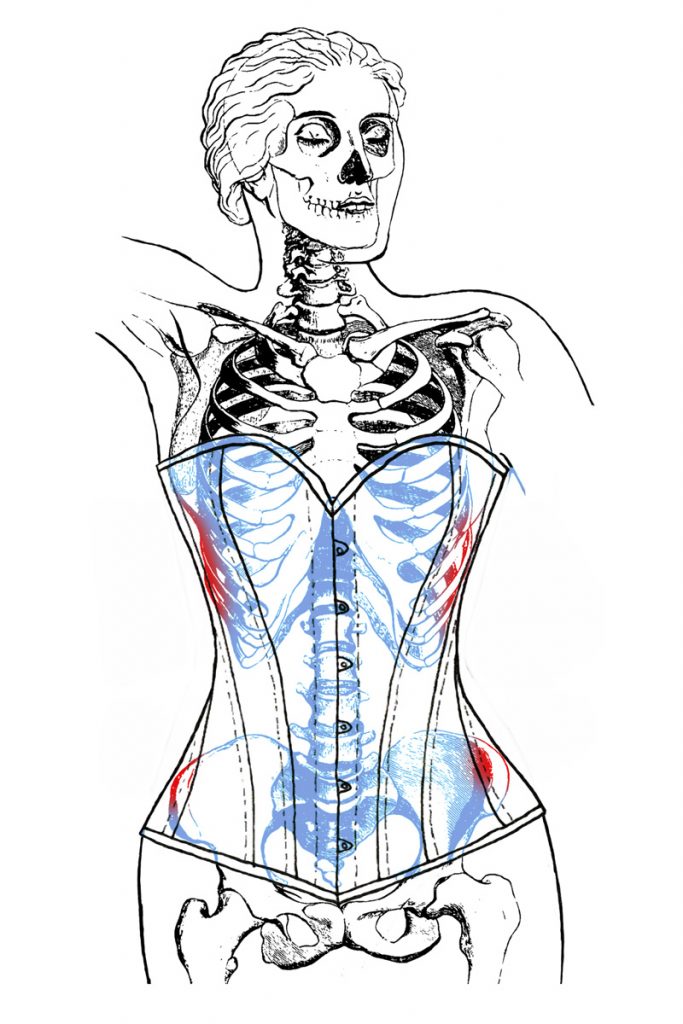
The shape of a “parenthesis” corset, in comparison to the shape of your bones
Your bones aren’t shaped like parenthesis! They curve in at the ribs and have a sharp curve at the hips. There are steel bones along each seam of the corset – and if the corset does not follow the shape of your bones, you will feel those steel bones digging in in places. The red in the sketch shows the spots on which you’re likely to feel some discomfort, when you wear a corset shaped like that.
The shape of an hourglass corset, in comparison to the shape of your bones
Hourglass corsets are much more comfortable. They curve with your bones, which keeps the corset’s bones from digging in.
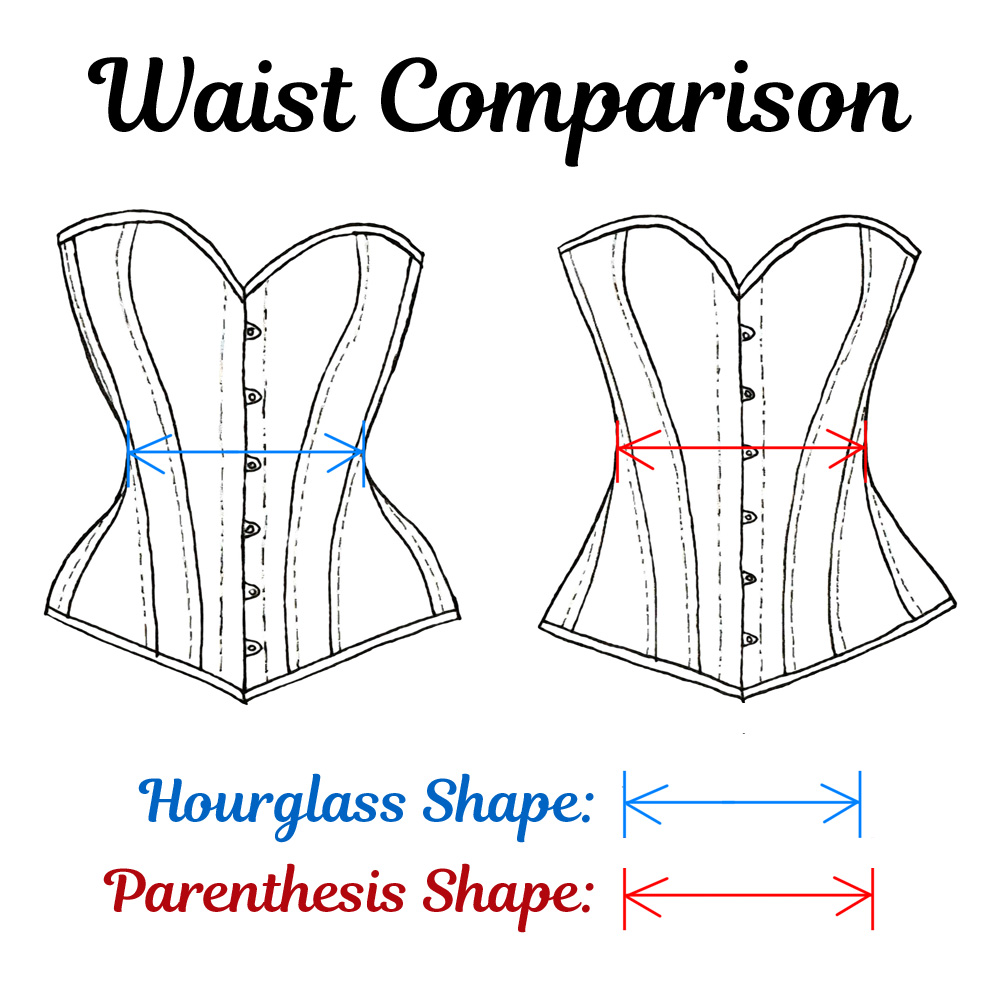
And here’s the really cool part. Hourglass corsets will actually make you look curvier – and make your waist smaller, while being more comfortable to wear than a corset with a “parenthesis” shape. This image shows just the corsets from my sketches above, with the comparison of the waist size for each. See the difference?
Hourglass Corset vs “Parenthesis” Corset
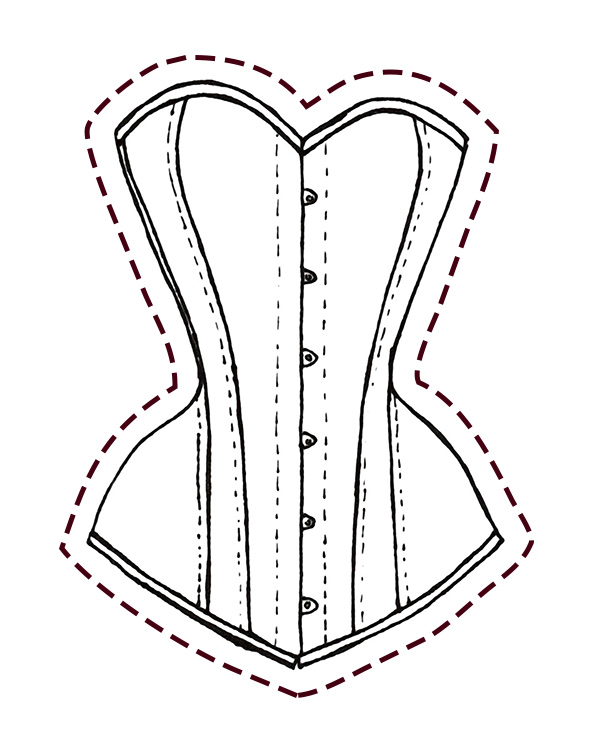
Most people prefer hourglass, but there are other shapes out there too. The picture below shows a conical or wasp waist corset. You wouldn’t typically purchase a corset with this shape unless you are a waist trainer (someone who wears a corset daily to reduce waist size). It will actually move your ribs. When I’m waist training, I like wearing underbust corsets that have this shape. Oddly, if I’m wearing a corset more than one day at a time, a conical shape feels more comfortable to me.
A Wasp (Conical) Waisted Corset
The shape below is called a pipe-stem corset, and it is only worn by serious waist trainers. It looks rather painful to me – so I’ve never tried it!
A Pipestem Corset
And those are the primary shapes of corsets that you’ll see when shopping today. I’ve drawn them in overbust, since that’s my personal preference – but all of these shapes come in underbust styles too. If you are looking at patterns – you’ll also see historical corset shapes. Women wore some form of corset for several centuries, so there were a ton of different styles throughout history! If you want to learn more about historical corset shapes, I wrote a post about it previously in this series.
I was surprised when I started working on this post – and came up with 18 different terms to explain to you! Corsets are a rather complex art – so to explain them well, it helps to dissect them into their parts – and define each one. In this part, we’ll cover everything that goes into making a corset, as well all the terminology you need to become a corset afficionado.
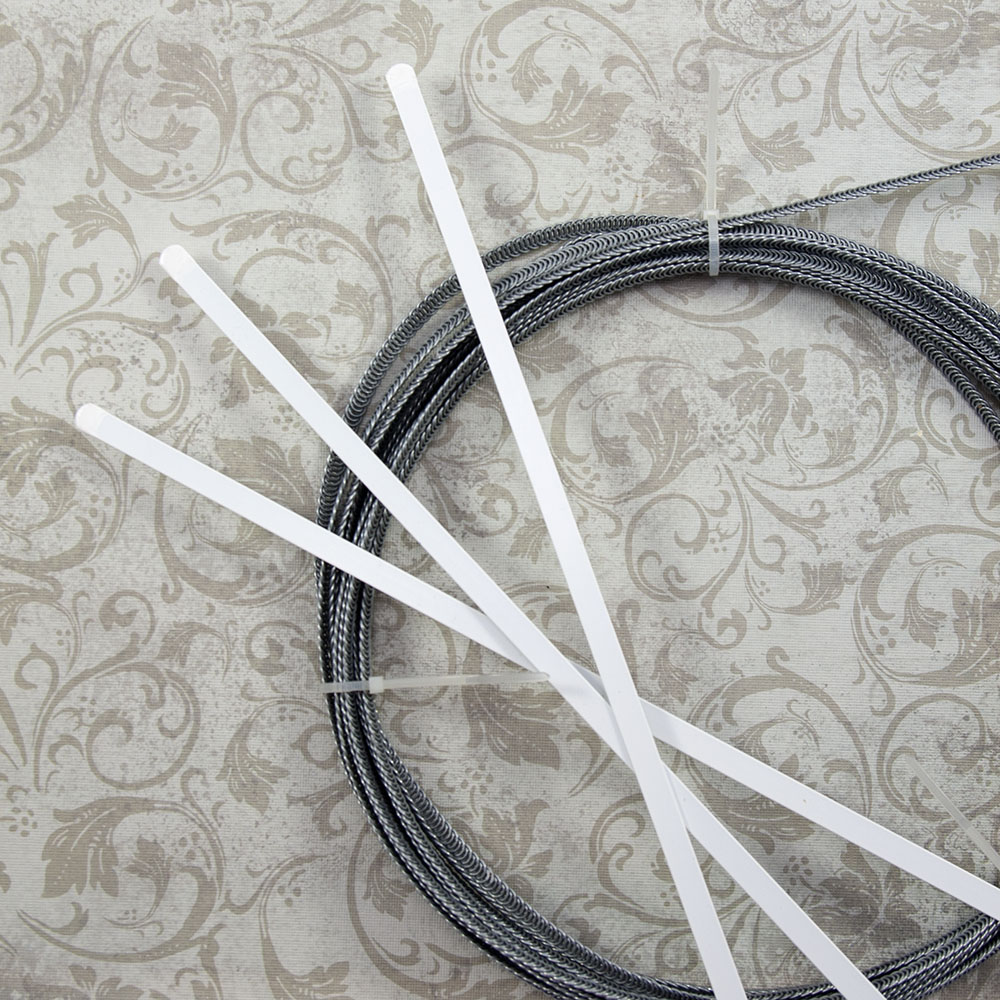
We’ll start with the boning. In most corsets, there is one steel bone along each seam, plus four in the back with the grommets. The jury is still out on this – but in my opinion, the nicest corsets have spiral steel bones over the bust and all around the sides. Sometimes you see them with flat steel – and some people prefer flat steel (saying it gives more support). Spiral steel bones are extremely flexible (while still being strong as steel) and they mold to your form without digging in. For me at least, the sensation of straight steel bones digging into my rib cage is extremely uncomfortable! So I use spiral steel for my corsets. The bones in the back beside the grommets, however, should be made from flat steel. They will keep the edges of your corset straight as you lace up into it.
Spiral and flat steel boning. I have spiral steel boning in long rolls because I use it in my evil queen collars!
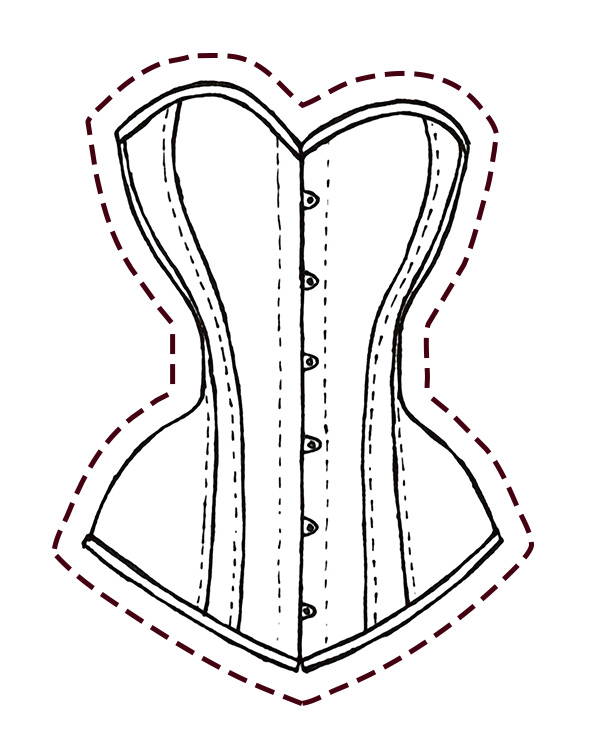
The diagram at left shows how the bones are placed in most corsets. This is called a “Single Steel Boned Corset”. But some corsets are double steel boned – meaning they have two spiral steel bones along each seam in place of one. To my knowledge, all double steel boned corsets are made with spiral steel. With two bones along each seam, you need that moldability! Waist training corsets are usually double steel boned, since they are extremely durable when made that way.
Placement of bones in a single steel boned corset.
Placement of bones in a double steel boned corset.
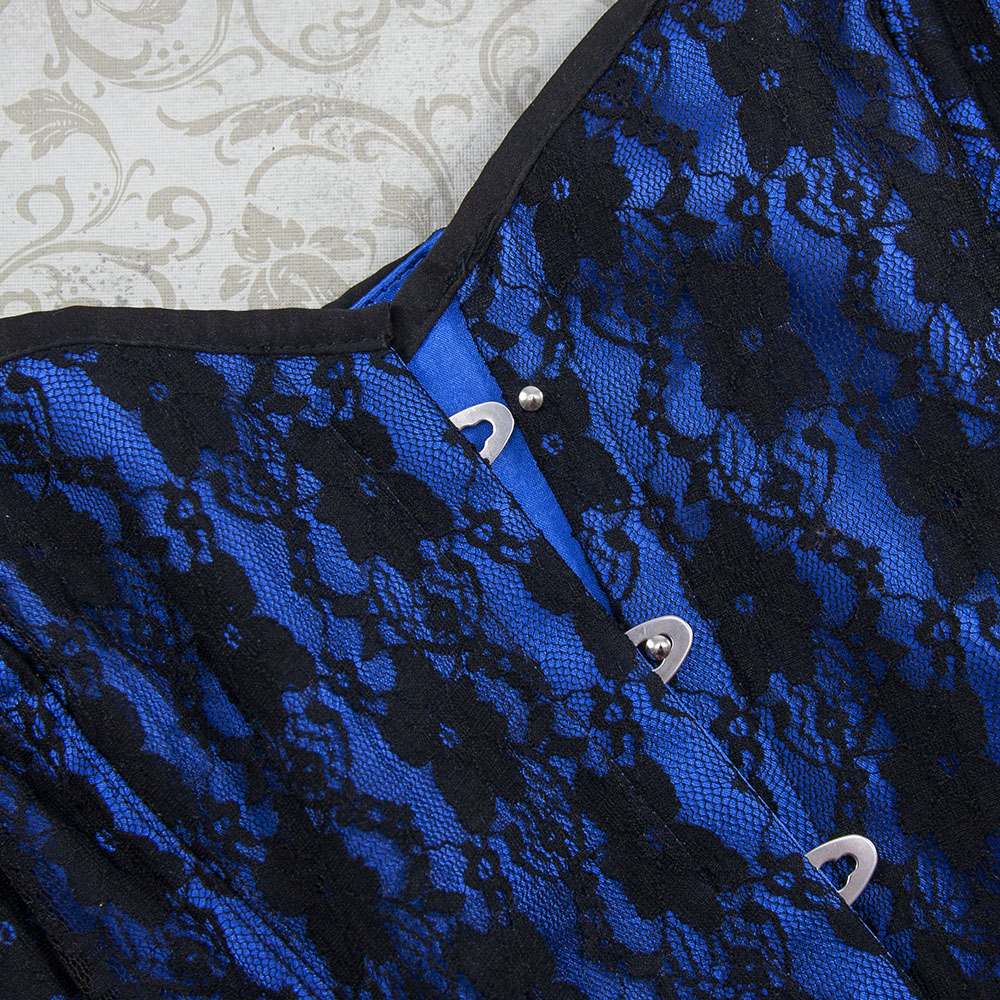
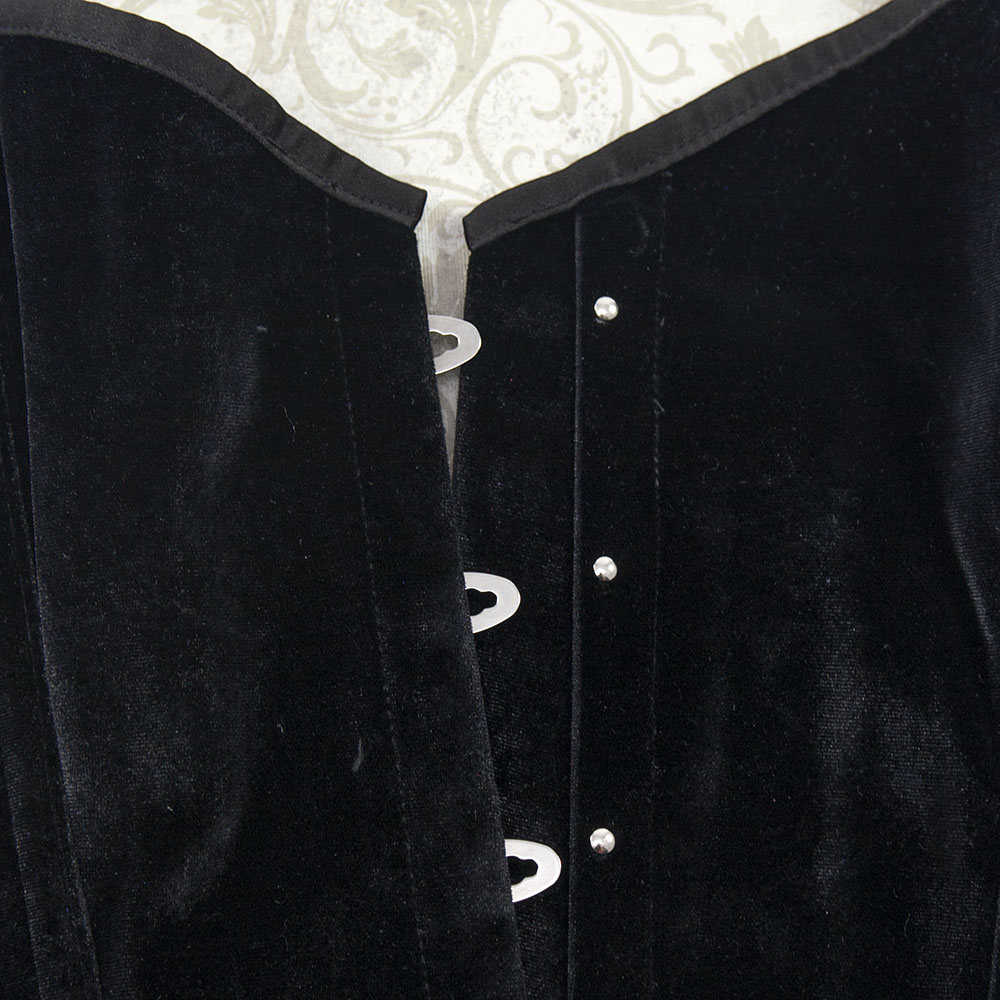
In the front of most corsets, you have a busk, with hooks all the way down. In some corsets, you instead have swing latches (or box clasps). You see swing clasp closures very often in Steampunk corsets.
This blue lace overlay corset features a busk closure.
This Steampunk corset features a swing latch closure.
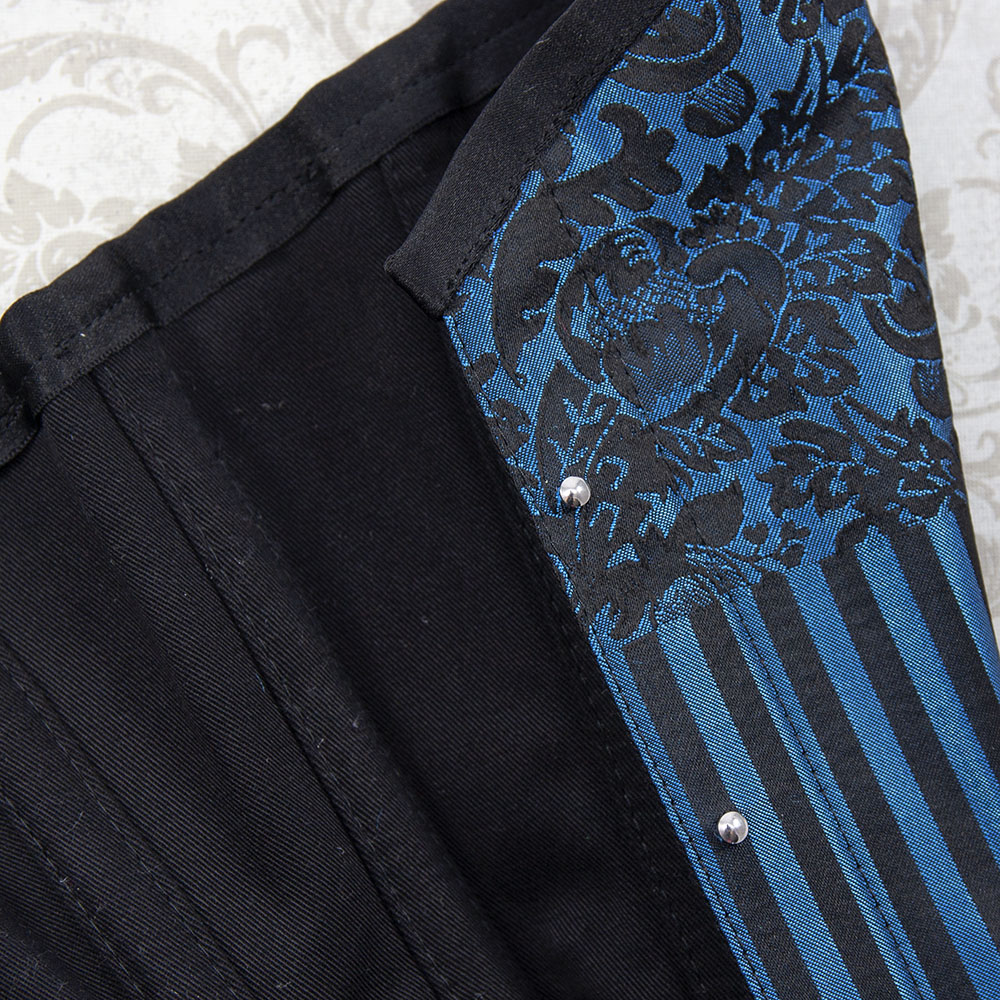
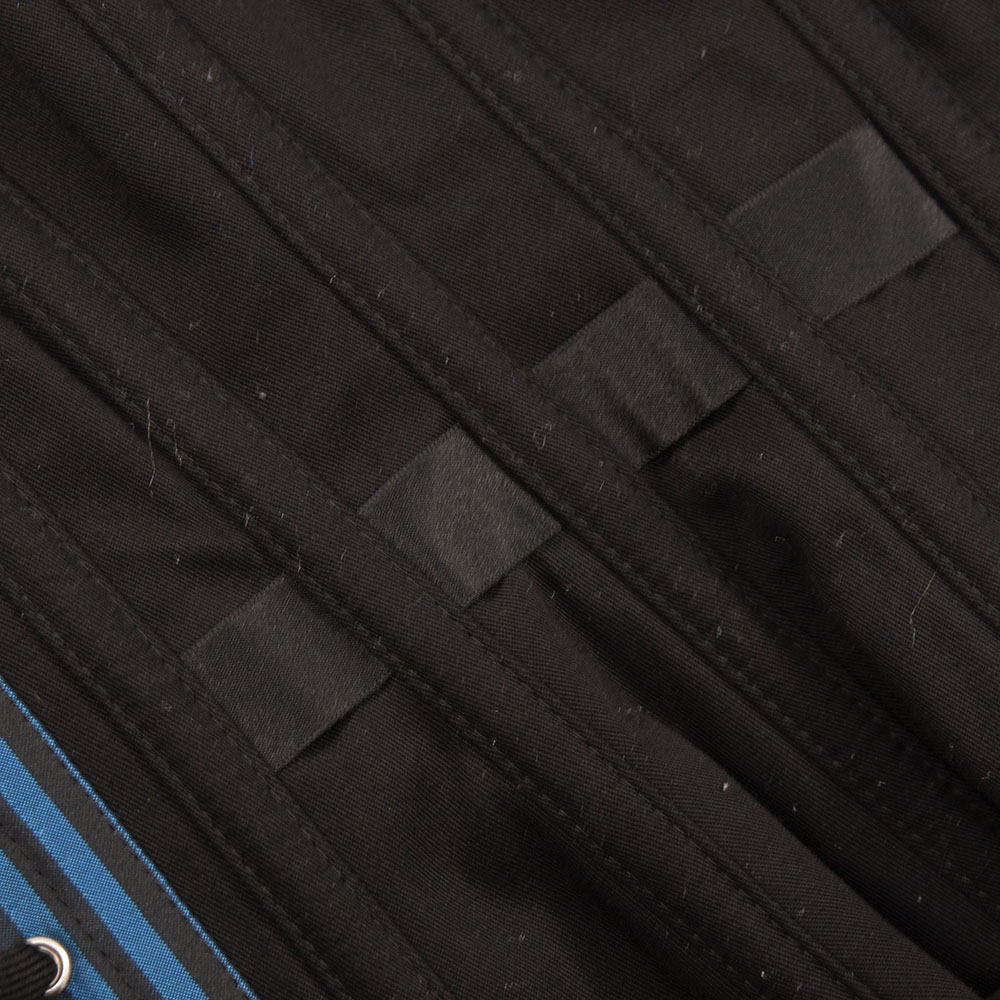
Corsets are made of two fabrics fused together. The outer fabric is called the “Fashion Fabric” and the inner fabric is called the “Strength Layer”. The fashion fabric will usually be something pretty – and the strength layer will be a nice thick coutil or cotton twill. There are boning channels sewn to the back of the corset, and the boning is inserted inside.
This corset has a two-tone blue brocade fashion fabric, and a cotton twill strength layer. The boning channels (seen on the inside) are also made of cotton twill.
Some corsets have reverse boning channels, which are made from a contrasting fabric and sewn to the outside instead of the inside. This makes a really cool decorative effect.
My stripe corset has reverse boning channels.
Some corsets have waist tapes. The waist tape reinforces the waist and keeps it from stretching. I chose to leave the waist tape out of my hourglass corsets, because I find that the corset has a smoother shape without it. I make these really pretty dress jackets, patterned to curve perfectly with the shape of my hourglass corsets. The smooth shape in the waist looks nicer with my jackets, so that’s what I did! But if you have bought a high quality corset elsewhere, you will likely see a waist tape on the inside.
A waist tape.
In the back, between the two flat steel bones, are grommets. (photos coming soon! Lol, I forgot to mention the grommets when I originally wrote this post, so I’m now adding them in way after the fact.) What are grommets? They are the metal pieces that protect the lacing holes from getting wallered out over time. You may think of them as “eyelets” – but eyelets are one piece. The front looks the same as a grommet, but in the back, eyelets have what looks like metal flower petals that spread out around the lacing hole. If you’ve bought a corset from a new maker, you might find eyelets instead of grommets. Grommets are two part. There is a front piece that curves around the back piece, and if set properly, both the back and the front is 100% smooth. The flower petal-ed back of an eyelet will cause lacing to fray over time, so for a long lasting corset, grommets are necessary.
In back under the lacing, your corset should have a modesty panel. This protects your back while lacing up, and covers up the crease you’ll have in your back after laced into the corset.
This corset’s modesty panel matches its fashion fabric.
More rarely, corsets will also have a modesty placket in front, to protect your stomach while hooking the busk, and cover the tiny space that can happen in front. My hourglass corsets have this piece. I accidentally hooked stomach skin into a busk on a corset once. (Holy friggin ouch!) Let me tell you, that experience will make you insist upon always having a modesty placket in the future!
Get a corset with a modesty placket if you can. The skin on your stomach will thank you!
The trim at top and bottom of the corset is called binding. It’s often made from the fashion fabric, or sometimes it’s made of contrasting fabric for a cool look.
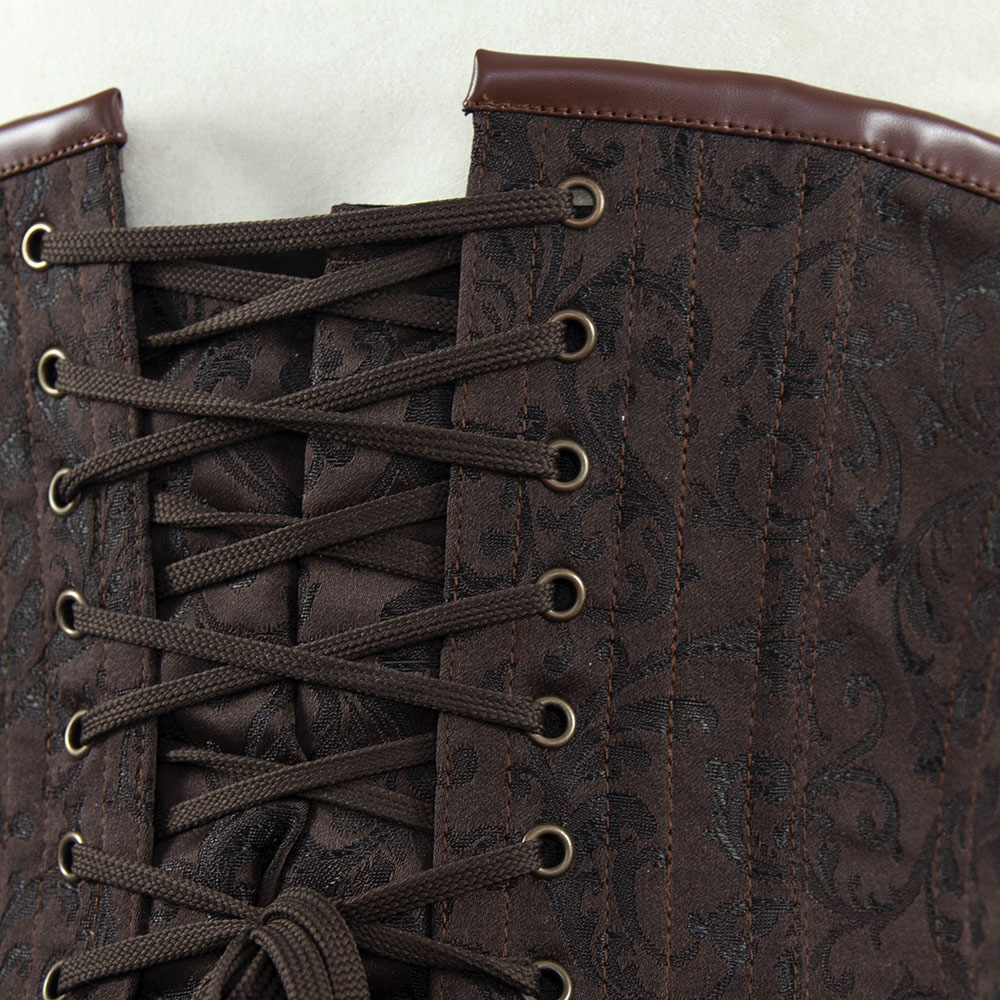
This corset has faux leather binding in a brighter shade of brown than the fabric, which provides a nice accent.
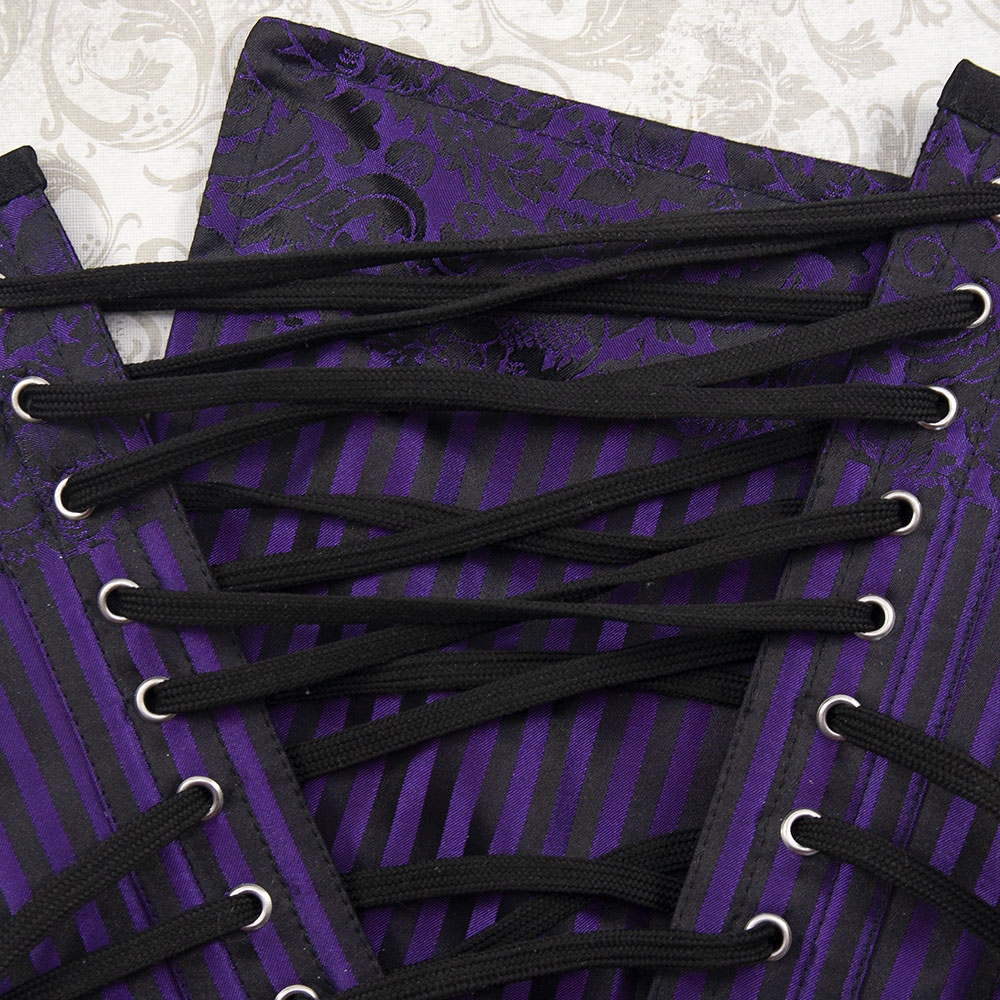
The lacing in back is extra long, so you can loosen the corset to a very wide gap in back to put it on. It’s laced so that there are bunny ears on either side at the waist – so they are easy to pull to tighten the corset.
That’s all the parts to a corset. Was it a bit more complex than you thought it would be? Coming next week, Corsets 101 part 5 – Pattern Matters
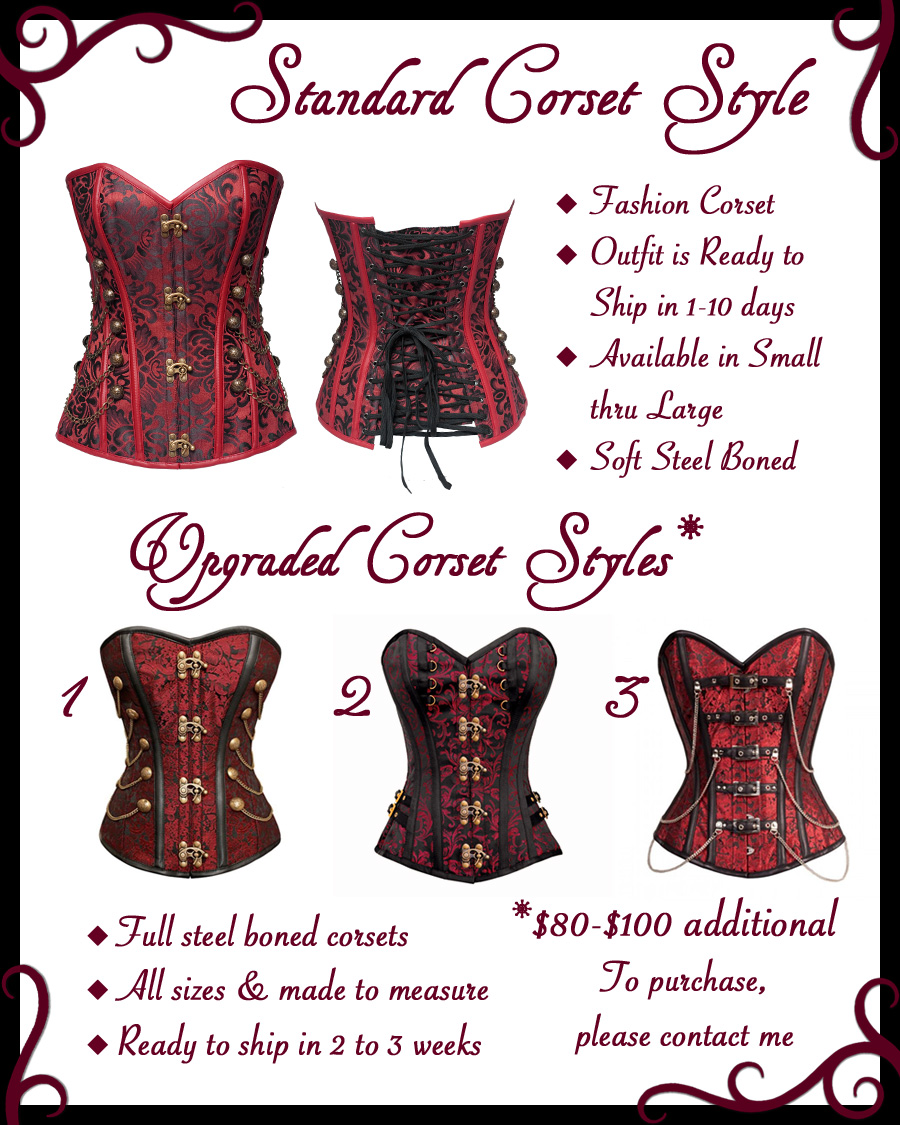
Welcome back to my series on corsets! Last week I talked about fashion corsets. And I shared a bunch of pretty pictures. Each and every one of the fashion corsets I carry has a “upgraded version” that I offer by special request. In most cases, the real corset costs at least twice as much. If you are new to corsets, you might be wondering – why buy a real corset, when fashion corsets are perfectly cute at half the cost?
I use this image in my etsy shop to show the real corset styles which match my ‘Lady in Red” steampunk costume.
Let me describe to you what it feels like to wear a real corset. Imagine a hug. A gentle squeeze, perfectly proportioned all around your torso. Imagine the best support you’ve ever felt (better than your best fitting bra) but with no weight on your shoulders, no elastic digging in anywhere. Then imagine looking at yourself in the mirror – and seeing this gorgeous curvy bombshell figure that you never knew you could have!
There is one very simple way to tell if you are purchasing a real corset or a fashion corset. How is it sized? If the sizes are Small/Medium/Large/etc, that’s a fashion corset. If the sizes are numbers, that’s a real corset.
The size tag in a fashion corset
The size tag in a real corset
Real corsets are designed to actually shrink your waist size, so they are sized by waist in inches. They have steel bones, a busk in front to clasp (typically), and lacing in back that is laced in an over-under style that makes them easy to pull tight. A good corset will be made nice and curvy, so that when you lace it tight it will squeeze your waist but curve out to give enough room for hips and bust.
Overbust Corsets
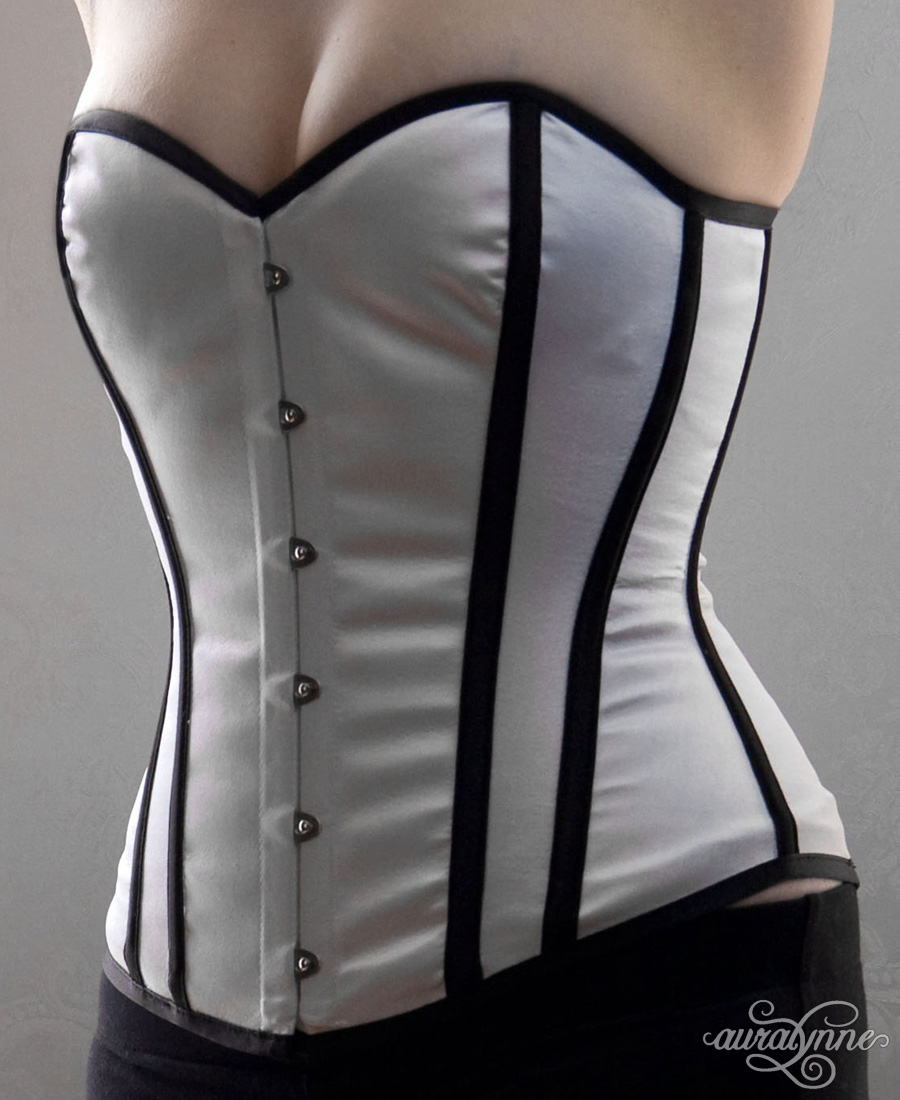
Overbust means, well, over the bust! An Overbust corset covers the bust, so you don’t need to wear anything underneath to cover your chest. I find that looks with overbust corsets are more elegant. Many people say that overbust corsets can have fit issues in the chest area, but I find this to not be a problem as long as the corset has a good pattern. My hourglass corsets, for instance, have been officially verified to fit perfectly on cup sizes from A to G.
Underbust Corsets
And similarly, I’m sure you’ve guessed that underbust means under the bust! If you’re wearing an underbust corset, you’ll need to wear a chemise or blouse underneath (at least to be legal in public!) You’ll have more mobility in an underbust corset, since it ends lower on your rib cage than an overbust. If you can find an underbust corset that fits you perfectly in height as well as size, you’ll find it to be the most comfortable style too.
Midbust Corsets
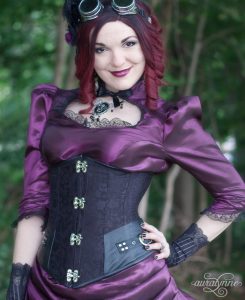
You see these much less often. Midbust corsets are somewhere in between under and overbust, and they are typically straight across the top. Authentic historical corsets were often midbust – as there would be several layers worn over the corset, and the corset wasn’t supposed to show! Midbust can be a great choice if you want to do a look inspired by the Tudor or Baroque era – since the necklines were extremely low and straight across in those days. Depending on your level of endowment, you may be able to get away with wearing a midbust corset without a chemise.
My “Airship Pirate” corset has a very similar shape to a midbust corset.
And those are the primary types of real corsets. Stay tuned for next week’s post, where I will talk about all the bits and pieces that go into making a corset.
Made-To-Order InformationAm I out of your size, or do you need a size other than what's listed? If you catch me at the right time, I offer this item made-to-order!
It's not available made-to-order right now, but enter your email below, and I'll reach out to you when it is: